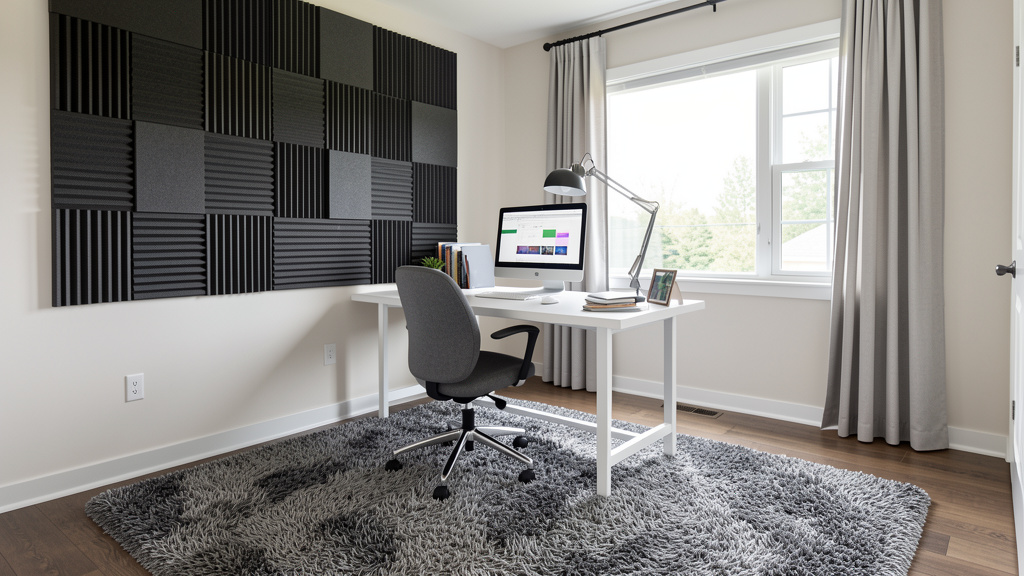
Transform your workspace into a sanctuary of concentration and professional audio excellence with science-informed strategies, adaptable solutions for every constraint, and a clear dual-goal framework—no construction expertise required.
If the hum of the refrigerator distracts you mid-sentence, distant conversations filter through your walls during critical calls, or traffic noise fractures your focus, you are navigating a shared challenge. Countless remote professionals contend with acoustic interference daily. This comprehensive guide clarifies the essential distinction between blocking external noise and managing internal reflections—two separate acoustic challenges requiring distinct approaches. We’ll guide you through diagnosing your specific environment, selecting appropriate interventions based on your constraints (renter status, budget, room size), and implementing solutions grounded in acoustic principles. By the conclusion, you’ll possess a personalized, actionable roadmap to cultivate a space that supports deep concentration and conveys professionalism through clear audio. No speculation, no oversimplification—only practical, adaptable steps informed by observable patterns in real-world implementations.
Introduction: Why Common “Soundproofing” Efforts Fall Short
You may have tried quick remedies: draping a blanket over the door, placing a rug on hard flooring, or enabling software noise suppression. Temporary relief sometimes follows—until a door slams, your voice echoes hollowly on a video call, or focus dissolves again. This cycle persists because most advice conflates two fundamentally different acoustic objectives. Noise intrusion (sound entering your space from outside) requires strategies centered on mass, sealing air pathways, and disrupting vibration transfer. Noise reflection (sound bouncing within your room) demands absorption, diffusion, and strategic placement of treatment materials. Addressing them interchangeably is ineffective—like using a raincoat to block wind. Understanding this distinction is your foundational step toward meaningful improvement.
Pattern-based observation of home office environments reveals a subtle truth: the most disruptive sounds are not always the loudest. A consistent low-frequency hum from HVAC systems or appliances can gradually erode cognitive stamina more than intermittent louder noises. Simultaneously, high-frequency reflections off hard surfaces create the “tin can” or “bathroom” audio effect that prompts colleagues to ask, “Where are you calling from?” Recognizing this duality shifts your approach from reactive fixes to intentional design. This guide synthesizes established acoustic principles with pragmatic, scalable interventions. Whether your workspace is a converted closet, a dedicated room, or a corner of a shared living area, the core concepts remain consistent. We begin not with products, but with perception—training your awareness to diagnose before deploying solutions.
The Dual-Goal Framework: Separating Concentration from Call Quality
Before considering any material or tool, internalize this foundational model. Every decision flows from one diagnostic question: “Am I primarily addressing external noise intrusion (to protect concentration) or internal sound reflection (to improve call clarity)?” Confusing these paths leads to misallocated effort and resources. Let’s clarify both with precision.
Goal 1: The Concentration Shield — Mitigating Unwanted Sound Intrusion
This addresses true sound isolation: reducing the transmission of sound energy across physical boundaries. Sound travels via airborne paths (voices, traffic, television) and structure-borne paths (footsteps, vibrations through walls/floors). Effective mitigation relies on three interrelated physical principles:
– Mass: Dense, heavy materials resist sound-induced vibration (e.g., multiple layers of drywall, specialized barrier materials).
– Sealing: Eliminating air gaps where sound leaks readily (around doors, windows, electrical fixtures).
– Decoupling: Creating separation between structural elements to interrupt vibration pathways (resilient channels, isolation clips, staggered framing).
Why this supports concentration: Unwanted auditory input triggers involuntary attention shifts. Environmental psychology research indicates that even low-level background speech can significantly impair reading comprehension and sustained focus. Your shield isn’t merely about comfort—it’s about preserving cognitive resources for meaningful work.
Goal 2: The Call Quality Catalyst — Shaping Internal Acoustics
This is acoustic treatment: managing how sound behaves within your enclosed space. When you speak, sound waves radiate outward, reflect off surfaces (walls, ceiling, desk), and return to your microphone. Hard, reflective surfaces amplify these reflections, causing echo, muddiness, or harsh resonances. Effective treatment employs:
– Absorption: Porous materials that convert sound energy into minimal heat (acoustic panels, thick textiles, specialized underlays).
– Diffusion: Irregular surfaces that scatter reflections to maintain natural ambience without disruptive echoes (bookshelves with varied-depth items, purpose-built diffusers).
– Bass Management: Targeted absorption in corners where low-frequency energy accumulates.
Why this supports professionalism: Your microphone captures the sum of your voice plus all room reflections. Unmanaged reflections increase the cognitive load for listeners, causing fatigue and reducing message clarity. Clean, controlled audio signals respect your audience’s attention and reinforces credibility.
The Fundamental Principle: Mass and sealing primarily address sound entering or leaving a space; absorption and diffusion manage sound within the space. Installing thin foam panels on walls will not meaningfully reduce neighbor noise. Adding mass to walls alone will not eliminate echo on calls. Mastering this distinction prevents common missteps and directs effort where it matters most.
Diagnosing Your Primary Challenge: A Practical 5-Minute Self-Assessment
Grab your phone and conduct this straightforward audit:
1. Record a 60-second monologue in your workspace with typical background conditions (HVAC running, distant household activity). Play it back critically. Do you hear distinct echoes? Does your voice sound hollow, boomy, or unnaturally bright? → Indicates a need for Call Quality Catalyst solutions.
2. Stand outside your closed workspace door. Have someone inside speak at a normal conversational volume. Can you clearly distinguish words? → Suggests significant air leakage (Concentration Shield priority).
3. Place your ear gently against the wall shared with the most problematic noise source (street-facing wall, adjacent living area). Is a low-frequency rumble (appliances, distant traffic) dominant? → Indicates a need for mass and decoupling strategies (advanced Concentration Shield).
4. Clap sharply once while standing in your typical seated position. Does the sound linger or “ring” noticeably? → Suggests excessive reverberation (Call Quality Catalyst priority).
This diagnosis prevents misdirected effort. A consultant near a busy street faces different challenges than a coach recording solo sessions in a quiet but reflective room. Your path diverges here—but both converge on intentional, informed action.
Part 1: Building Your Concentration Shield — Reducing External Noise Intrusion
Effective sound isolation functions as an integrated system. Imagine your room as a container: sealing one leak while ignoring others yields limited results. We’ll address vulnerabilities systematically, prioritizing actions with the highest impact relative to effort and cost. Critically, always address air leaks before adding mass—sealing gaps consistently delivers more noticeable improvement than doubling wall mass alone in typical residential settings.
Step 1: Seal the Most Common Leakage Points — Doors and Windows
Doors and windows typically account for the majority of sound leakage in standard interior rooms. Even a narrow gap beneath a door transmits significant sound energy. This represents your highest-impact starting point for most situations.
Why this step is foundational: Sound exploits the path of least resistance. A room with well-constructed walls but an unsealed door will perform poorly acoustically. Physics dictates that isolation effectiveness is limited by the weakest point in the assembly—sealing gaps addresses this principle directly.
How to implement effectively:
– Door Perimeter Sealing:
– Top/Sides: Apply adhesive-backed EPDM rubber weatherstripping tape (approximately 1/4-inch thick profile). Clean the door jamb thoroughly with isopropyl alcohol before application. Press firmly along the entire contact surface. “V-strip” or bulb-style profiles accommodate minor unevenness better than flat tape. Practical Check: Close the door on a dollar bill around the entire perimeter. If you feel consistent resistance when pulling it out, the seal is adequate. If it slides freely in spots, reinforce those areas.
– Bottom Gap: This is often the most significant leakage point. For a durable solution, consider an automatic door bottom—a spring-loaded seal that deploys when the door closes and retracts when opened. For renters or temporary setups, a weighted draft stopper (“door snake”) filled with dense material (sand, rice) conforms to floor irregularities. Position it snugly against the interior face of the closed door.
– Window Treatment:
– Operable Windows: During colder months, removable interior window insulation kits (clear plastic film stretched taut over the frame) add an extra air barrier. For year-round use, compression-fit cellular shades with side channels trap air and block sound paths. Heavyweight thermal curtains (fabric weight of 18+ ounces per square yard) hung on a rod extending at least 6–12 inches beyond the window frame on all sides significantly reduce mid- and high-frequency transmission. Critical Detail: Ensure curtains extend to pool slightly on the floor and overlap the wall generously at the sides to minimize edge leakage.
– Fixed Windows or Severe Noise: For persistent issues (proximity to airports, major roads), adding a secondary interior glazing layer can be highly effective. Acrylic sheeting (lighter and safer than glass) mounted in a separate frame 2–4 inches from the existing window creates a decoupled air gap. Seal all edges meticulously with acoustic sealant.
Common pitfalls to avoid:
– Using low-density foam tape that compresses permanently; EPDM rubber maintains resilience longer.
– Installing a door sweep that drags excessively, causing operational issues or preventing full closure.
– Hanging curtains too close to the window frame, allowing sound to bypass the treatment.
– Overlooking the top of the door; light (and sound) leakage here is common.
Adaptable Implementation Paths:
– Immediate Action ($15–$30): Weighted draft stopper + removable weatherstripping tape. Offers noticeable reduction in audible leakage for minimal investment.
– Targeted Upgrade ($100–$200): Automatic door bottom seal + high-quality cellular shade with side channels. Addresses the majority of door and window leakage points durably.
– Comprehensive Approach ($300+): Secondary interior glazing panel + professional-grade perimeter seals. Suitable for severe noise environments where significant isolation is required.
Illustrative Scenario: A professional working in a converted urban bedroom found afternoon focus consistently disrupted by street noise. Installing thermal blackout curtains extending well beyond the window frame and adding an automatic door bottom seal to the hollow-core door transformed the acoustic environment. Street noise shifted from clearly intelligible conversation to a distant, non-intrusive murmur, reclaiming productive work hours without structural modification.
Step 2: Strengthening Wall Performance — From Surface Adjustments to Structural Enhancements
Walls represent the next critical barrier. Standard hollow-core interior walls offer limited inherent isolation. Upgrades focus on adding mass, damping vibration, or decoupling layers—always prioritizing the wall facing the dominant noise source. Crucially, address penetrations before adding surface treatments.
Understanding Wall Dynamics:
– Typical Construction: 1/2-inch drywall on wood studs provides modest isolation (often rated STC 25–35 in lab conditions; real-world performance is usually lower).
– Critical Weak Points: Electrical outlets, switch boxes, and gaps at the top/bottom plates of walls create flanking paths for sound. Sound travels freely through these cavities.
– The Mass Principle: Increasing mass generally improves isolation, but with diminishing returns. Sealing all gaps consistently yields greater real-world improvement than adding mass over unsealed penetrations.
How to implement effectively:
– Phase 1: Seal Wall Penetrations (Essential First Step)
– Turn off power at the circuit breaker. Remove outlet and switch cover plates.
– Insert non-hardening acoustic putty pads behind each electrical box. These conform to irregular shapes and block sound paths into the wall cavity.
– Fill gaps around boxes with acoustic sealant—a flexible, non-hardening compound designed to remain pliable for decades. Avoid standard silicone or latex caulk, which hardens, cracks, and loses effectiveness over time.
– Where feasible and appropriate, consider retrofit electrical boxes with integrated gaskets.
– Phase 2: Add Mass and Damping (Select Based on Constraints)
– Renter-Friendly Surface Treatment: Mass-loaded vinyl (MLV) panels add significant density without permanent attachment. Mount using heavy-duty removable adhesive hooks or secure behind tension-mounted fabric art. Key Insight: MLV must be installed without gaps. Overlap seams generously and seal with acoustic tape if possible. Even small gaps significantly compromise performance.
– Permanent Upgrade Path A (Strong Value): Add a second layer of 5/8-inch Type X drywall over existing walls. Apply a viscoelastic damping compound (such as Green Glue Noiseproofing Compound) between the layers. This converts sound vibration energy into negligible heat through shear movement. Secure the new drywall directly to the studs for structural integrity. Seal all perimeter edges with acoustic sealant.
– Permanent Upgrade Path B (Highest Performance): Implement decoupling using resilient channels or sound isolation clips before adding the new drywall layer. This creates a physical separation between the drywall and studs, breaking the vibration path. This approach represents the gold standard for new construction or major renovations but typically requires professional installation for optimal results.
Common pitfalls to avoid:
– Skipping penetration sealing; adding mass over unsealed outlets is ineffective.
– Using rigid construction adhesive between drywall layers; damping compounds are specifically formulated for this purpose.
– Installing MLV loosely or with wrinkles, which creates resonant air pockets.
– Neglecting adjacent surfaces; sound travels vertically. If noise originates from above (footsteps) or below (garage), address ceiling or floor paths too (see Step 3).
Adaptable Implementation Paths:
– Immediate Action ($40–$60): Seal all electrical outlets and switches on the primary noise-facing wall with putty pads and acoustic sealant. Surprisingly effective for reducing mid- and high-frequency transmission.
– Targeted Upgrade ($250–$600): Install MLV panels covered with decorative fabric on the shared wall, secured with removable methods. Provides meaningful improvement without demolition.
– Comprehensive Approach ($1,200+): Full wall assembly upgrade with isolation clips/channels, double drywall layers, and damping compound. For dedicated studios or severe noise challenges.
Illustrative Scenario: A consultant sharing a wall with a high-traffic family kitchen experienced frequent call interruptions. After sealing all electrical penetrations, they installed two 4×8-foot MLV panels covered in burlap fabric on the shared wall, secured with heavy-duty tension rods. The combined cost was under $250. Kitchen noise transformed from clearly understandable speech to indistinct background presence, drastically reducing call disruptions.
Step 3: Addressing Vertical Noise Paths — Floors and Ceilings
Footsteps from above, vibrations from below, or HVAC noise transmitted through the ceiling can undermine efforts focused solely on walls and doors. Solutions must align with the noise type (airborne vs. impact) and your access/control.
Floor Solutions:
– For Impact Noise Originating Above (e.g., footsteps): If you control the space above, adding a thick rug with a dense acoustic underlay (rubber or felt, rated for sound reduction) is the single most effective step. For your workspace floor, a high-pile rug (wool or dense synthetic) with a dedicated acoustic underlay placed under your desk area absorbs residual vibration and adds comfort.
– For Noise Entering From Below: If accessible, adding insulation between floor joists in the space below helps. For most, focus upward: Interlocking acoustic underlayment tiles (like those used under floating floors) placed in your primary work zone add mass and decoupling. Renter Alternative: Dense interlocking rubber gym tiles (8mm+ thickness) in the desk area provide noticeable impact noise reduction and are fully removable.
Ceiling Solutions:
– Primary Strategy: Install suspended acoustic clouds or baffles hanging 12–18 inches below the ceiling, positioned over your desk area. These absorb reflected sound and add a layer of mass/damping. Select panels with a high Noise Reduction Coefficient (NRC > 0.8) and Ceiling Attenuation Class (CAC > 35) where ratings are available.
– Advanced: If attic access exists above, adding dense insulation (mineral wool batts) between joists and sealing gaps around fixtures with acoustic sealant helps. For severe overhead impact noise, a fully decoupled ceiling system (isolation clips + channels + drywall) is required—but this is a significant renovation.
Critical Nuance: Floor and ceiling treatments primarily address impact noise and low-frequency transmission. They complement wall and door sealing but rarely resolve airborne noise alone. Prioritize based on your diagnosis: If upstairs footsteps are the primary issue, floor treatment is critical. If street noise enters via windows, ceiling work is a lower priority.
Adaptable Implementation Paths:
– Immediate Action ($60–$100): Place a large, thick wool or high-pile area rug (8’x10′) with a dedicated acoustic underlay under your desk and chair.
– Targeted Upgrade ($300–$500): Install three to four acoustic clouds strategically hung over the desk area. Reduces both overhead noise perception and internal reflections.
– Comprehensive Approach ($1,500+): Floating floor underlayment system or suspended acoustic ceiling grid with high-performance tiles.
Illustrative Scenario: A professional working in a converted garage office found overhead footsteps disruptive. Installing interlocking 1/2-inch rubber gym tiles across the entire floor area significantly reduced the perception of impact noise. Combined with door sealing, this created a noticeably calmer environment for afternoon focus sessions.
Step 4: Managing HVAC and Ventilation Noise
HVAC systems are frequent, overlooked sources of distraction. Constant airflow creates cognitive load, and ductwork acts as a conduit for noise from other areas of the home.
How to implement effectively:
– Seal Accessible Duct Leaks: Use mastic sealant (not standard duct tape) on accessible duct joints near your workspace. Leaks amplify noise and reduce efficiency.
– Consider Duct Liners: Flexible internal duct liners with absorptive material can reduce noise within the duct. Best installed during professional HVAC service.
– Acoustic Vent Covers: Replace standard plastic vent covers with models featuring internal baffles designed to disrupt sound paths while maintaining airflow. Look for products specifying acoustic performance.
– Strategic Placement Awareness: During renovations, avoid placing supply and return vents directly opposite each other on parallel walls, which can create direct sound pathways. Offset placement is preferable.
Adaptable Implementation Paths:
– Immediate Action ($15–$25): Place a small piece of acoustic foam behind (not blocking) the vent cover to dampen resonance. Modest effect, but immediate.
– Targeted Upgrade ($75–$150): Install an acoustic baffle vent cover on your workspace supply vent. Noticeable reduction in airflow “whoosh” noise.
– Comprehensive Approach ($400+): Professional installation of an inline duct silencer (attenuator). Ideal for severe HVAC noise or open-plan duct systems.
Illustrative Scenario: A remote worker’s office vent transmitted noticeable airflow noise and occasional mechanical sounds from the furnace area. Replacing the standard vent cover with an acoustic baffle model reduced the constant background hum to a barely perceptible level, eliminating the need for masking noise during quiet work periods.
Part 2: Cultivating Crystal-Clear Call Quality — Mastering Internal Acoustics
With your Concentration Shield strengthened, turn inward. Close the door. Speak aloud. Does your voice sound natural, or does it echo? Does a finger snap create a lingering “ping”? This domain—acoustic treatment—shapes the sound within your controlled space. Unlike isolation (keeping sound out), treatment manages reflections after sound is generated inside. This is essential for microphone fidelity and listener comfort.
Step 1: Mapping Your Room’s Acoustic Behavior — Identifying Reflection Points
Every room has predictable zones where sound reflections cause issues for recording or calls. Identify these before placing treatment.
The Mirror Technique (for Primary Reflection Points):
1. Sit in your normal working position.
2. Have a helper hold a hand mirror flat against the side wall.
3. Slide the mirror along the wall until you can see your computer monitor/screen in the mirror.
4. Mark that spot. This is a primary reflection point—where sound from your voice (or speakers) reflects directly toward your microphone or ears.
5. Repeat for the opposite wall, the ceiling (above your monitor), and the floor (if hard-surfaced).
Why this works: Sound reflects predictably, similar to light. Treating these precise locations yields maximum impact with minimal material. Random panel placement is inefficient.
Additional Critical Zones:
– Corners (Vertical and Ceiling-Wall): Low-frequency sound energy accumulates where surfaces meet, causing “boomy” or muddy audio. Bass management here is essential.
– Rear Wall: Reflections off the wall behind you can create slap-back echo or phase issues with directional microphones.
– Desk Surface: Hard desks reflect sound upward toward your microphone. A dense desk pad or felt mat helps absorb these early reflections.
Step 2: Purposeful Absorption — Strategic Panel Placement
Absorption panels convert sound energy into minimal heat. Material composition and thickness determine effectiveness across the frequency spectrum.
Material Considerations:
– Thin Foam (1-inch): Primarily absorbs high frequencies (reducing sibilance like “s” sounds). Leaves mid- and low-frequencies largely unaffected, potentially resulting in an unnatural or “muffled” vocal quality. Common in inexpensive kits; generally not ideal for speech clarity.
– Optimal for Voice (2–4 inches thick): Rigid mineral wool (rockwool) or fiberglass panels wrapped in acoustically transparent fabric absorb the full speech frequency range (approximately 125 Hz to 4000 Hz). Two-inch panels handle mid/high frequencies well; four-inch panels provide significant low-mid absorption. Look for panels with an NRC rating of 0.8 or higher.
– Placement Strategy (The Targeted Approach):
– Primary Reflection Points: Install one panel at each mirror-identified location on side walls.
– Front Wall: Place a panel centered behind your monitor, at seated head/microphone height.
– Rear Wall: One panel centered at seated head height reduces slap-back reflections.
– Ceiling Cloud: Hang one panel 12–18 inches below the ceiling, centered between your head and monitor. Critical for mitigating ceiling reflections—a frequent cause of “hollow” sounding audio.
Why thickness matters: Low-frequency wavelengths are long (e.g., a 100 Hz wave is approximately 11 feet long). Thin materials cannot effectively interact with these wavelengths. Thicker panels absorb deeper frequencies, resulting in warmer, clearer, more natural-sounding voice reproduction. For speech-focused environments, 2 inches is a practical minimum; 3–4 inches is ideal for comprehensive control.
Pre-Made vs. DIY Considerations:
– Pre-Made Panels: Reputable acoustic brands offer tested, fire-rated panels with professional finishes. Higher initial cost but guaranteed performance and aesthetic integration. Ideal when budget allows or visual cohesion is important.
– DIY Panels: Cost-effective and customizable. Core: Rigid mineral wool (e.g., Roxul Safe’n’Sound) or fiberglass (Owens Corning 703/705) panels, 2″ or 4″ thick. Wrap tightly in breathable fabric (burlap, Guilford of Maine). Build a simple wooden frame. Critical Safety Note: Wear appropriate PPE (respirator mask, gloves, eye protection) when handling insulation cores. Seal all edges thoroughly to prevent fiber release. Verify that core materials and fabric meet local fire safety standards (most rigid mineral wool/fiberglass is non-combustible).
Common pitfalls to avoid:
– Covering entire walls with thin foam, creating an unnaturally “dead” space while failing to address low-end issues. Strategic placement of adequately thick panels is far more effective.
– Placing panels too high or too low; target seated head/microphone height (typically 4–5 feet from the floor).
– Using fabric that isn’t acoustically transparent (e.g., vinyl, thick plastic coatings). Sound must pass through the fabric to reach the absorptive core. Test by attempting to blow air through the fabric—if air passes easily, sound will too.
– Neglecting corners; low-frequency buildup significantly impacts vocal clarity on recordings.
Adaptable Implementation Paths:
– Immediate Action ($50–$80): Hang two thick moving blankets or quilts at primary reflection points using tension rods or removable hooks. Provides immediate, noticeable reduction in harsh reflections.
– Targeted Upgrade ($250–$550): Install four 2’x4′ x 2″ thick panels (pre-made or DIY) at key reflection points plus one bass trap in a front corner. Transforms perceived audio quality on calls.
– Comprehensive Approach ($900+): Six to eight panels (including a ceiling cloud), two to four corner bass traps (4″ thick), and a diffuser on the rear wall to maintain natural ambience without echo.
Illustrative Scenario: A sales professional received consistent feedback about “echoey” audio during video conferences. Using the mirror technique, they identified reflection points and installed three 2’x4′ x 2″ DIY mineral wool panels (covered in neutral fabric) at side wall locations and one behind the monitor. Total material cost was under $250. Colleagues immediately noted the significant improvement in audio clarity, and feedback about audio quality ceased.
Step 3: Managing Low-Frequency Energy — Bass Traps for Clarity
That persistent “boomy” or “hollow” quality in recordings often stems from low-frequency buildup in corners. Standard absorption panels are too thin to address these long wavelengths effectively. Bass traps are thicker, denser absorbers designed specifically for corner placement.
Why corners matter: Sound pressure is highest where two or three surfaces intersect. Low frequencies accumulate in these zones like water in a corner. Untreated, this buildup masks vocal clarity and causes microphones to capture unnatural resonance.
Effective Bass Trap Approaches:
– Panel Traps: Thick (4″+) absorptive panels mounted vertically in corners, spanning from floor to ceiling or wall to ceiling. Most effective type for speech environments. DIY using 4″ mineral wool panels framed to fit the corner angle.
– Furniture Integration: Dense, irregularly filled bookshelves placed in corners provide functional diffusion and modest absorption. Better than untreated corners.
– Advanced DIY: Packing dense mineral wool insulation tightly into the entire corner cavity (floor to ceiling) and covering with fabric. Highly effective but permanent.
Placement Priority:
1. Front corners (nearest your desk/workspace) – most critical for microphone position.
2. Rear corners.
3. Ceiling-wall corners (if low-end issues persist after treating vertical corners).
Adaptable Implementation Paths:
– Immediate Action ($0): Position a densely filled bookshelf in the front corners. Provides irregular absorption and diffusion. A practical starting point.
– Targeted Upgrade ($120–$180 per corner): Build or purchase two 4-foot-tall x 4″-thick panel traps for front corners. Dramatically cleans up vocal low-mids.
– Comprehensive Approach ($450+): Floor-to-ceiling bass traps in all four vertical corners. Studio-grade low-end control.
Illustrative Scenario: A solo podcast creator recording in a small office struggled with a persistent muddy quality in voice tracks. Installing two DIY 4″-thick mineral wool bass traps (4 feet tall) in the front corners near the microphone yielded an immediate improvement: vocals gained definition and warmth without artificial equalization. Post-production editing time was noticeably reduced due to cleaner source audio.
Step 4: Microphone Technique — The Final Critical Element
Even excellent room treatment is undermined by suboptimal microphone placement and selection. Your microphone is the final link in the audio chain.
Optimal Setup Practices:
– Distance: Position the microphone 6–12 inches from your mouth. Closer proximity reduces room sound pickup (leveraging the proximity effect, which gently boosts lower frequencies—often flattering for voice). Greater distance increases room sound capture.
– Angle: Point the microphone slightly off-axis from your mouth (e.g., 10–15 degrees downward toward your chest). This naturally reduces plosive sounds (“p”, “b”) without requiring a pop filter. If using a pop filter, position it 2–3 inches from the microphone grille.
– Height: The microphone diaphragm should be level with or slightly below your mouth when seated upright.
– Directionality: Use a microphone with a cardioid (heart-shaped) pickup pattern. This rejects sound from the rear and sides, focusing on your voice. Avoid omnidirectional microphones in untreated or minimally treated rooms—they capture sound equally from all directions.
– Isolation: A shock mount is essential. It isolates the microphone from desk vibrations (keyboard clicks, mouse movements). A modest investment here often yields greater clarity improvement than expensive software fixes.
Software as a Supplement, Not a Solution: Noise suppression tools (Krisp, NVIDIA RTX Voice, etc.) can help mask minor residual issues but often introduce artifacts (“underwater” sound, voice cutting out). They perform best after physical treatment has reduced the ambient noise floor. Prioritize treating the room; use software for fine-tuning, not as a primary fix.
Illustrative Scenario: After implementing room treatment, a content creator still noticed faint keyboard noise on recordings. Mounting the microphone on a boom arm with a shock mount and positioning it precisely 8 inches from the mouth at a slight downward angle eliminated the issue. The resulting audio was consistently clear, demonstrating how technique amplifies the value of physical treatment.
Part 3: Real-World Applications — Tailored Pathways for Common Scenarios
Theory gains value through practical application. Below are adaptable blueprints addressing frequent constraints. Your situation has likely been navigated before—these approaches are informed by observed patterns.
The Urban Apartment Renter: Landlord-Approved, Non-Permanent Solutions
Constraints: Cannot modify walls, doors, or windows permanently. Budget-conscious. Solutions must be removable upon moving.
Action Plan:
1. Door: Install a high-quality weighted draft stopper ($25) and removable adhesive weatherstripping tape on the door frame ($15). Hang a heavy quilt or tapestry over the interior door surface using removable hooks ($30–$50 used). Impact: Significantly reduces door leakage.
2. Windows: Install tension rod-mounted thermal blackout curtains extending 12+ inches beyond the frame on all sides ($70–$90). Add removable window film kits seasonally ($20). Impact: Meaningful reduction in street noise, particularly mid/high frequencies.
3. Walls: Create “acoustic art panels.” Mount mass-loaded vinyl sheets onto lightweight foam core boards, cover with fabric matching your decor. Secure to walls using heavy-duty removable adhesive hooks rated for the weight. Place on the wall shared with the noisiest area. Impact: Adds meaningful mass without damage; easily removed with no residue when hooks are used per instructions.
4. Internal Acoustics: Use tension rods to hang thick blankets or DIY fabric-wrapped panels at reflection points. Place a large area rug with a dense rubber underlay. Position bookshelves filled with books against reflective walls (provides diffusion and absorption). Impact: Noticeable improvement in call clarity and reduced echo.
5. Desk Zone: Consider a compact reflection filter positioned behind the microphone for focused treatment.
Total Estimated Investment: $220–$380. Time Commitment: One weekend. Expected Outcome: Significant reduction in noticeable noise intrusion and echo. Landlord perceives only decorative elements (curtains, art, rug).
The Budget-Conscious Implementer: Maximizing Impact Per Dollar
Constraints: Limited total budget ($300–$600). Willing to DIY. Prioritizes highest-return actions.
Action Plan (Phased Approach):
– Phase 1 (Week 1, ~$90): SEALING. Weatherstripping tape for door ($15), draft stopper ($25), acoustic sealant + putty pads for all outlets on the primary noise-facing wall ($50). Rationale: Sealing gaps consistently delivers the most noticeable improvement per dollar spent.
– Phase 2 (Week 2, ~$220): INTERNAL ACOUSTICS. Build four 2’x4′ x 2″ DIY absorption panels (mineral wool core, fabric wrap). Place at primary reflection points. Add one DIY bass trap in a front corner. Rationale: Directly addresses the most common professional pain point (call quality) with moderate investment.
– Phase 3 (Ongoing, ~$130): FLOOR/CEILING. Large thick rug with acoustic underlay ($100). Hang one acoustic cloud over the desk area using ceiling hooks ($30). Rationale: Addresses vertical reflections and adds comfort.
– Phase 4 (Future Goal, ~$120): DOOR UPGRADE. Save for an automatic door bottom seal. Rationale: Represents the single highest-impact upgrade for concentration after initial sealing.
Why this sequence works: It follows the principle of addressing the weakest links first. Sealing gaps provides immediate, perceptible improvement. Internal treatment solves critical communication issues. Phasing prevents overwhelm and allows evaluation of effectiveness at each stage.
The Permanent Renovation: Building an Acoustically Optimized Space
Constraints: New construction, major remodel, or dedicated structure (e.g., backyard office). Goal: Optimal performance. Budget is secondary to results.
Action Plan (Integrated Design):
1. Wall Construction: Staggered stud walls or double stud walls with an air gap. Fill cavity with dense-pack cellulose or mineral wool insulation. Install sound isolation clips + resilient channels. Apply two layers of 5/8″ drywall with damping compound between layers. Seal all perimeter edges meticulously. Target: High STC rating for robust isolation.
2. Door: Solid core door (minimum 1.75″ thick) with automatic door bottom seal and full-perimeter acoustic seals. For extreme isolation, consider a soundlock vestibule (two doors with an air gap).
3. Windows: Dual-pane windows with laminated glass and differing pane thicknesses to disrupt resonance. Install within a separate frame with acoustic sealant. Consider an exterior storm window for an additional air gap.
4. Floor/Ceiling: Floating floor underlayment system over subfloor. Suspended acoustic ceiling grid with high-CAC tiles. Insulate ceiling cavity above with mineral wool.
5. HVAC: Dedicated duct run with inline silencer. Acoustic vent covers. Ensure adequate fresh air exchange without noise ingress.
6. Internal Treatment: Comprehensive coverage: Bass traps in all corners (floor-to-ceiling), absorption panels at all reflection points, diffusers on rear walls, ceiling clouds. Professional acoustic analysis is highly recommended during the design phase.
Professional Collaboration: Engaging an acoustic consultant during design ($500–$1,500) prevents costly errors and ensures optimal material selection and placement. This investment is frequently justified for a critical, permanent workspace.
The Compact Workspace (Closet Office or Small Room): Working Within Tight Constraints
Constraints: Very small room (< 8’x10′). Parallel walls exacerbate standing waves. Limited placement options.
Special Considerations:
– Bass Buildup is Pronounced: Prioritize bass traps in all four vertical corners, floor-to-ceiling if feasible. This is essential in small volumes.
– Avoid Over-Absorption: Covering every surface creates an unnaturally “dead,” potentially uncomfortable space. Balance absorption with diffusion. Place bookshelves with varied-depth books on one wall. Use a diffuser panel on the rear wall.
– Desk Placement: Avoid centering the desk. Position it asymmetrically (e.g., one-third of the way into the room) to disrupt standing wave patterns.
– Ceiling Focus: Hang at least one thick absorption cloud. Small rooms have strong ceiling reflections.
– Ventilation Awareness: Small, sealed spaces can become stuffy. Ensure adequate airflow (small quiet fan, strategic window cracking with acoustic consideration when not in use).
Key Insight: In compact spaces, precision of treatment placement matters more than quantity. Targeting critical zones based on the reflection map yields better results than blanket coverage. Measure thoughtfully, treat intentionally.
Navigating Common Challenges: Pitfalls and Practical Corrections
Even well-intentioned efforts encounter obstacles. Awareness of these frequent challenges helps you course-correct efficiently.
Challenge 1: Confusing Acoustic Treatment with Sound Isolation
The Misstep: Purchasing thin foam panels marketed as “soundproofing,” applying them to walls, and being disappointed when external noise remains unchanged.
Why It Happens: Marketing terminology often blurs the critical distinction between blocking sound transmission (isolation) and managing internal reflections (treatment).
The Correction: Revisit the Dual-Goal Framework. For reducing noise entering the space: prioritize mass, sealing, and decoupling. For improving sound within the space: prioritize adequately thick absorption (2″+ mineral wool/fiberglass), bass management, and diffusion. Check product specifications: look for STC ratings (isolation) versus NRC ratings (absorption).
Challenge 2: Overlooking Flanking Paths
The Misstep: Perfectly sealing the office door but neglecting the gap under the hallway door leading to a noisy area. Sound finds the path of least resistance.
Why It Happens: Focusing narrowly on the most obvious barrier while missing secondary transmission paths (shared ducts, ceiling plenums, adjacent walls, plumbing chases).
The Correction: Conduct a holistic “sound path audit.” Trace the likely route of the problematic noise from its source to your ears. Seal gaps along the entire path. Pay close attention to: HVAC vents, electrical conduits, ceiling gaps above partition walls, and shared structural elements.
Challenge 3: Over-Treating the Room
The Misstep: Covering every wall surface with thick absorption, resulting in an unnaturally “dead,” potentially claustrophobic space that feels uncomfortable for extended work.
Why It Happens: The misconception that “more treatment is always better,” without understanding balanced acoustics.
The Correction: Target treatment strategically using the reflection map. Preserve some natural ambience. Use diffusion (bookshelves with books of varying depths, purpose-built diffusers) on rear walls instead of absorption. Aim for a balanced reverberation time suitable for speech—a space that feels quiet but not tomb-like. Test by clapping: decay should be quick but not instantaneous.
Challenge 4: Material Selection and Safety
The Misstep: Using inappropriate or unsafe materials (e.g., loose fiberglass insulation without containment, flammable fabrics near heat sources, standard caulk that hardens and cracks).
Why It Happens: Following outdated advice or prioritizing low cost over safety and long-term performance.
The Correction:
– Safety First: Wear appropriate PPE (N95 respirator, gloves, eye protection) when handling insulation materials. Use fire-rated materials compliant with local codes. Ensure DIY panel cores are fully sealed so fibers cannot escape.
– Material Integrity: Select products designed for acoustic applications: acoustic sealant (remains flexible), mass-loaded vinyl (verified density), rigid mineral wool/fiberglass (consistent density). Avoid loose-fill insulation in DIY wall cavity applications—it can settle and lose effectiveness.
– Verify Claims: Reputable manufacturers provide independent laboratory test reports (STC, NRC, IIC ratings). Seek this information when evaluating products.
Challenge 5: Integrating Aesthetics and Human Comfort
The Misstep: Creating a technically effective acoustic space that feels cold, institutional, or visually jarring, reducing your desire to spend time there.
Why It Happens: Prioritizing technical specifications over human experience and visual harmony.
The Correction: Integrate treatment seamlessly into your design:
– Cover panels with fabric that complements your decor (linen, burlap, custom-printed textiles).
– Frame panels like artwork; arrange them symmetrically or in intentional groupings.
– Leverage functional furniture: Bookshelves (filled with books) act as diffusers. Thick curtains serve dual purposes (light control + absorption). Area rugs define space and absorb sound.
– Incorporate biophilic elements: Leafy plants (snake plant, peace lily, ZZ plant) provide minor diffusion and significant psychological benefits—studies link biophilic design to reduced stress and improved cognitive function.
– Prioritize lighting: Warm, layered lighting counteracts any potential sterility of acoustic treatments. Your space should feel inviting and supportive first, technically optimized second.
When Professional Guidance Is Warranted
While most home office scenarios are well-suited to informed DIY implementation, seek expert assistance when:
– Structural modifications are required (new walls, decoupled ceilings/floors).
– Noise sources are extreme or persistent (adjacent commercial venues, airport flight paths, industrial vibration).
– Low-frequency issues (HVAC rumble, traffic vibration) resist standard treatments.
– Budget allows for optimization to prevent wasted effort (an acoustic consultant provides targeted specifications).
– Health or safety concerns exist during renovation (asbestos, lead paint).
A qualified acoustic consultant (look for affiliation with organizations like the Acoustical Society of America) can perform measurements, model solutions, and specify materials. For construction work, engage contractors with documented experience in sound isolation techniques—standard builders may lack this specialized knowledge.
Your Questions, Answered
Q: Can I make meaningful improvements on a very tight budget? What’s the single most impactful low-cost step?
A: Absolutely. The highest impact per dollar is consistently sealing air gaps, particularly around the door. A quality weighted draft stopper ($20–$30) combined with adhesive weatherstripping tape ($15) can significantly reduce noticeable noise leakage. This addresses the “weakest link” principle—sound exploits tiny gaps disproportionately. Next, seal electrical outlets on the noise-facing wall with acoustic putty pads ($10 for a pack). These steps cost under $50 and often yield the most perceptible initial improvement. For call quality, hanging two thick moving blankets at primary reflection points using tension rods ($30–$40) noticeably reduces echo. Success on a budget lies in strategic targeting, not expensive materials.
Q: Do soundproofing curtains actually provide meaningful noise reduction?
A: Yes, but with important qualifications. Effective acoustic curtains are heavyweight (minimum 18–22 ounces per square yard fabric weight), multi-layered (often incorporating a dense core like mass-loaded vinyl or specialized batting), and installed correctly. They must extend at least 6–12 inches beyond the window frame on all sides and pool slightly on the floor to minimize sound leakage around the edges. Standard “blackout” curtains offer minimal acoustic benefit. Look for products specifying an STC (Sound Transmission Class) rating of 20 or higher for meaningful performance data. They are most effective against mid- and high-frequency noise (traffic, voices) but have limited impact on low-frequency rumble (subway trains, heavy bass). They work best as part of a layered strategy (combined with window sealing and other treatments), not as a standalone solution.
Q: I rent an apartment. Will adding mass to my walls violate my lease or disturb neighbors?
A: Non-permanent solutions like removable MLV panels mounted on frames using heavy-duty removable adhesive hooks (e.g., 3M Command™ Picture Hanging Strips rated for the weight) typically pose no risk to neighbors and comply with standard lease terms, as they cause no damage to walls when removed per instructions. Avoid attaching anything directly to walls with nails or screws without explicit landlord permission. Focus efforts on elements you fully control: sealing your door, adding rugs with underlays, and treating internal acoustics. These actions improve your experience without altering the building structure. If concerned, frame solutions as “decorative wall hangings” or “thermal curtains.” Always review your specific lease agreement regarding modifications, but non-invasive treatments are generally acceptable. The goal is enhancing your personal workspace environment.
Q: Why does my voice still sound echoey on calls after adding foam panels?
A: This commonly stems from one or more of these factors: 1) Insufficient Panel Thickness: Thin (1″) foam primarily absorbs high frequencies, leaving mid- and low-frequency reflections that cause muddiness. Upgrade to panels that are 2–4 inches thick, made of mineral wool or rigid fiberglass. 2) Suboptimal Placement: Panels may not be positioned at the primary reflection points. Use the mirror technique to identify the exact spots where sound reflects to your microphone. 3) Lack of Bass Management: Low-frequency buildup in corners creates a “boomy” foundation that makes voice sound hollow. Add thick bass traps (4″+) to the front corners near your desk. Additionally, verify your microphone technique: use a cardioid-pattern microphone positioned 6–12 inches away, slightly off-axis, mounted on a shock mount. Software noise suppression cannot compensate for poor room acoustics and may introduce artifacts.
Q: Is damping compound (like Green Glue) worth the investment for wall upgrades?
A: For permanent wall or ceiling upgrades where adding a second layer of drywall is feasible, viscoelastic damping compound is widely regarded as a highly cost-effective component. It is specifically formulated to convert sound vibration energy into negligible heat between two rigid layers (like drywall). Unlike standard construction adhesive, it remains flexible, creating a constrained-layer damping system. Independent laboratory testing indicates it can improve STC ratings significantly compared to drywall alone—often providing performance gains equivalent to adding substantial mass. For the material cost per square foot, the performance improvement is notable. It is not a sealant (use acoustic sealant for gaps) and not effective as a standalone product. Its value is realized within a layered assembly: drywall + damping compound + drywall.
Q: How can I reduce noise from footsteps above my workspace?
A: Footsteps represent impact noise, requiring different strategies than airborne noise. Solutions depend on access and control:
– If you control the space above: Installing a thick rug with a dense acoustic underlay (rubber or felt) on the floor above your office is the single most effective solution.
– If you only control your ceiling: Adding mass and decoupling (isolation clips + channels + drywall layers) provides the most significant reduction but is a major renovation.
– Practical Compromise: Install dense acoustic clouds or baffles hanging 12–18 inches below your ceiling. While primarily designed for absorption, the added mass and air gap provide modest impact noise reduction. Combine this with a thick rug and acoustic underlay on your floor to absorb residual vibration. For shared living situations, a collaborative discussion about adding rug + underlay upstairs can be a mutually beneficial solution.
Q: Do plants contribute meaningfully to soundproofing?
A: Plants offer negligible sound isolation (blocking external noise). A few leaves cannot stop sound wave transmission. However, they provide modest acoustic treatment benefits: dense foliage can slightly diffuse high-frequency reflections, reducing harshness. More significantly, their psychological impact is well-documented. Research in environmental psychology confirms that biophilic elements (plants, natural materials, views of nature) reduce stress, lower physiological markers of strain, and support cognitive function and mood. In a space designed for sustained focus, this contribution to well-being is substantial. Place leafy plants on shelves, desks, or floors—they break up large flat surfaces (adding subtle diffusion) and enhance the human experience of the space. View them as valuable complementary elements for holistic workspace design, not primary acoustic solutions.
Q: What is the essential difference between sound absorption and sound blocking? Why is this distinction critical?
A: This distinction is the cornerstone of effective acoustic strategy:
– Sound Blocking (Isolation): Aims to prevent sound from entering or leaving a space. Requires strategies involving mass (dense materials), sealing (airtight gaps), and decoupling (breaking vibration paths). Measured by STC (Sound Transmission Class). Goal: Protect concentration from external disturbances.
– Sound Absorption (Treatment): Manages sound within a space by reducing reflections and reverberation. Uses porous or resonant materials (mineral wool, fabric, specialized foams) to convert sound energy. Measured by NRC (Noise Reduction Coefficient). Goal: Improve clarity and quality of sound captured by microphones or perceived by listeners inside the room.
Why it matters profoundly: Installing absorption panels (like foam) does almost nothing to block neighbor noise. Adding mass to walls does little to fix echo on your microphone. Confusing these objectives leads to wasted resources, frustration, and ineffective outcomes. Always begin with diagnosis: “Is the core issue sound coming in (requiring blocking/isolation) or sound bouncing around (requiring absorption/treatment)?”
Q: Must I treat the entire room, or can I focus treatment around my desk area?
A: For call quality and internal acoustics, strategic treatment focused on your workspace “sweet spot” is highly effective and efficient. Prioritize: primary reflection points (side walls, front wall behind monitor), a ceiling cloud above the desk, bass traps in the front corners near your position, and a rug underfoot. This targeted approach optimizes resources. For concentration (blocking external noise), the entire room envelope matters because sound leaks through the weakest point. However, prioritize surfaces facing the dominant noise source (e.g., the wall shared with a street or busy room). You do not need perfect isolation on all sides; significantly weakening the main intrusion path yields the greatest perceptual benefit. Start targeted, then expand treatment incrementally if needed based on results.
Q: Will thorough sound sealing make my room feel hot or stuffy?
A: Sealing gaps improves energy efficiency by reducing drafts, but reduced airflow can lead to stuffiness if not managed. Proactively address ventilation:
– Ensure your HVAC system provides adequate fresh air exchange to the room.
– Use a small, quiet desk fan on a low setting for gentle air movement; the subtle white noise can also mask residual distractions.
– If windows are sealed tightly for noise control, consider cracking a window in another room to allow whole-house airflow, or explore an energy recovery ventilator (ERV) for dedicated fresh air intake without significant noise ingress.
– Select breathable acoustic materials (fabric-wrapped panels, natural fiber rugs) over completely sealed surfaces.
Thoughtfully executed sound management enhances overall comfort by eliminating drafts, but intentional ventilation planning is essential for long-term usability and well-being.
Q: How can I objectively assess whether my soundproofing efforts are working?
A: Combine subjective and accessible objective methods:
– Subjective Comparison: Before-and-after reflection. Note specific changes: “Can I still hear the dishwasher running during calls?” “Does my voice sound clearer on recordings?” Keep a simple log of observations.
– Smartphone Tools: Use a reputable decibel meter app (like NIOSH SLM) to measure relative noise levels inside your office with the door closed. Play consistent noise outside (TV at fixed volume), measure the dB reduction after sealing the door. Note: Phone microphones aren’t laboratory-grade, but consistent relative changes are valid indicators.
– The Clap Test: A sharp clap in the room’s center. Notice how long the sound lingers (reverberation time). Less “ring” indicates improved absorption.
– Recording Test: Record yourself speaking normally in the space. Critically listen back. Is background noise less prominent? Is echo reduced? Compare recordings made before and after treatment.
– Professional Assessment: For critical applications, an acoustic consultant with calibrated equipment can measure STC (isolation) and RT60 (reverberation time).
Ultimately, the most important metric is perceived improvement in your daily work experience—reduced distraction, clearer communication, and greater comfort.
Q: Are there documented well-being benefits to improving my home office acoustics?
A: Yes, significantly. Chronic exposure to unwanted noise is recognized as a environmental stressor. The World Health Organization identifies environmental noise as a public health concern, associated with elevated stress hormone levels, increased cardiovascular strain, sleep disruption, and impaired cognitive performance. By cultivating a calmer acoustic environment:
– You reduce allostatic load (the cumulative physiological burden of chronic stress), supporting long-term cardiovascular and mental health.
– Uninterrupted focus periods lower mental fatigue and reduce burnout risk.
– Clearer audio on calls minimizes communication strain and social friction.
– Enhanced psychological safety emerges from feeling in control of your immediate environment.
This investment extends beyond productivity metrics; it is a foundational element of a healthy, sustainable workspace that honors both professional effectiveness and personal well-being. A thoughtfully managed acoustic environment supports holistic health.
Conclusion: Your Path to a Calmer, More Effective Workspace
You now possess a clear, adaptable framework for improving your home office acoustics. This journey is not about achieving perfection overnight—it’s about making intentional, incremental progress aligned with your unique situation, constraints, and goals. Let’s consolidate the essential path forward.
Three Foundational Principles
- Diagnose Before You Act: Never skip the simple self-assessment. Clarifying whether your primary challenge is external noise intrusion (Concentration Shield) or internal reflections (Call Quality Catalyst) ensures your effort and resources are directed effectively. Targeting the right problem is the majority of the solution.
- Seal Before You Add Mass: Air gaps are the most common vulnerability in sound isolation. Weatherstripping, door seals, and outlet sealing consistently deliver disproportionate improvements. Addressing leaks is the essential first step before considering heavier interventions.
- Strategic Placement Over Blanket Coverage: For internal acoustics, place adequately thick absorption panels (2″+) at identified reflection points and bass traps in corners. Avoid covering every surface. Precision and intentionality yield better results and a more comfortable environment than saturation.
The 24-Hour Rule: Your Immediate, Actionable Step
Today, identify one small, concrete action you can complete within the next 24 hours:
– If noise leaks under your door: Order a weighted draft stopper online, or create a temporary test version by tightly rolling a towel.
– If calls sound echoey: Use the mirror technique to find one reflection point. Hang a thick blanket or quilt there tonight using a tension rod or removable hook.
– If feeling overwhelmed: Seal one electrical outlet on your noisiest wall with an acoustic putty pad (available at hardware stores or online).
This micro-action breaks inertia. Completion builds confidence and momentum. Tomorrow, you will be further along than most who only contemplate solutions. Progress compounds with consistent, small steps.
The Broader Perspective: Acoustics as Part of Workspace Well-Being
Your home office is more than a location for tasks—it is a cognitive and emotional ecosystem. Acoustics profoundly influence focus, communication quality, stress levels, and professional presence. By thoughtfully shaping this dimension, you reclaim agency over your environment. You transform distraction into sustained attention, frustration into flow, and unclear audio into confident communication. This is not merely technical optimization; it is designing a space that respects your work and supports your well-being. The principles explored here extend naturally to other living spaces—home theaters, nurseries, bedrooms—enriching your entire environment. You have gained a practical lens for perceiving and positively influencing the sonic landscape around you.
The quiet you cultivate is not empty silence—it is the fertile ground where clarity, creativity, and meaningful connection can flourish. Begin with one small step. Build deliberately. Your more focused, professional, and peaceful workspace awaits.
Explore Our Complete System:
Designing an Ergonomic Home Office Layout | Mastering Natural Light for Screen Comfort | Air Quality and Thoughtful Plant Selection for Cognitive Support | Invisible Cable Management Systems | Biophilic Design Principles for Daily Calm | Choosing Task Lighting to Reduce Eye Strain | Creating a Distraction-Free Digital Workspace