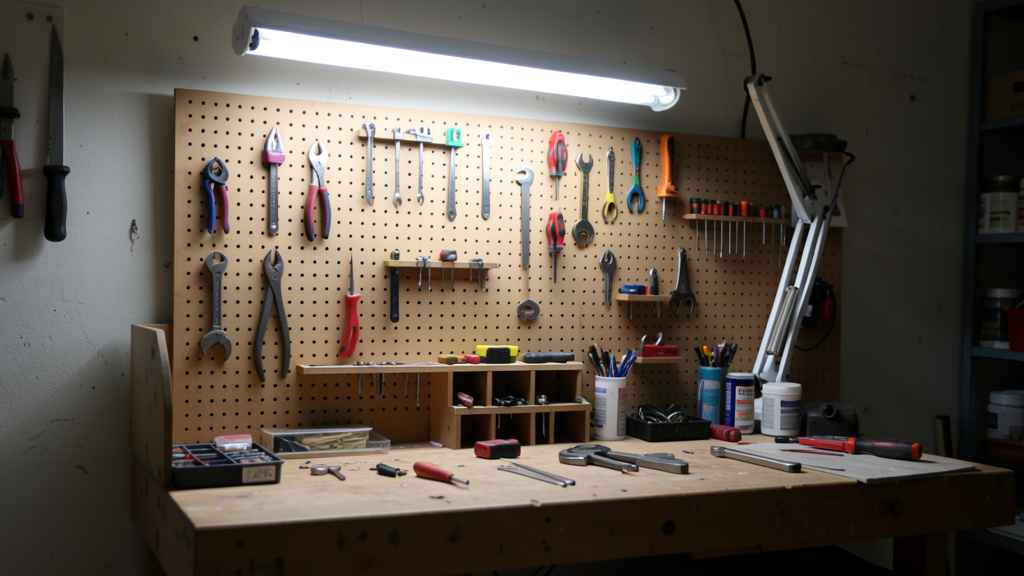
Transform any garage, basement, or spare room into a workshop that supports your workflow, prioritizes safety, and evolves with your skills—thoughtfully designed for real-world constraints.
Imagine entering a space where tools reside in intuitive locations, the work surface aligns with your natural posture, and movement between tasks flows without obstruction. This is not an idealized fantasy but an achievable outcome of deliberate workshop design. Whether adapting a compact garage nook or organizing a dedicated basement area, this guide delivers a structured framework to cultivate a workspace that enhances focus, safeguards well-being, and accommodates your unique project rhythm. Each phase includes adaptable solutions for varying spatial limitations, budget considerations, and evolving skill levels—because the most effective workshop reflects your process, not a generic template.
Introduction: Why Thoughtful Layout Amplifies Every Tool You Own
Many enthusiasts initially prioritize acquiring tools over designing their environment. Yet a cluttered floor, poorly positioned lighting, or inefficient tool placement can undermine even premium equipment—increasing setup time, straining the body, and introducing preventable hazards. Environmental psychology research indicates that organized, purpose-driven spaces reduce cognitive load, allowing mental energy to focus on creation rather than navigation. Safety frameworks from organizations like OSHA consistently identify workspace layout as foundational to accident prevention: tripping hazards, inadequate clearance around equipment, and poor ventilation contribute significantly to workshop incidents. This guide synthesizes established ergonomic principles, electrical safety standards, and adaptable design strategies to help you cultivate a space that serves you reliably across seasons and skill levels.
Before measuring walls or selecting storage, anchor your approach in this principle: Your workshop must align with your predominant activities, physical needs, and spatial realities. There is no universal “perfect” layout—but there is a reliable process to discover what works for you. Begin by observing your current workflow patterns and pain points.
The Workshop Blueprint Framework: Plan, Zone, Equip, Optimize
Creating a functional workshop hinges on a sequential, repeatable system—not replicating magazine spreads. The Workshop Blueprint Framework unfolds in four interdependent phases. This structure prevents common pitfalls (like installing cabinetry before confirming electrical pathways) and ensures each element serves a clear purpose within your context.
- Phase 1: Plan – Clarify primary uses, assess spatial constraints, and draft a scaled layout.
- Phase 2: Zone – Define functional areas (cutting, assembly, finishing) to streamline movement.
- Phase 3: Equip – Select and position core components: work surface, storage, lighting, utilities.
- Phase 4: Optimize – Refine for safety, ergonomics, and future adaptability.
This phased approach transforms complexity into manageable steps. Proceed deliberately—each phase informs the next.
Phase 1: Plan – Laying the Groundwork for Long-Term Functionality
Skipping thorough planning often leads to rework, frustration, and compromised safety. This phase demands honest assessment and precise documentation—not assumptions.
Step 1: Clarify Your Workshop’s Primary Function
Ask: What activity will occupy 80% of my time here?
– Woodworking Focus: Prioritizes dust management, stable assembly surfaces, and robust workholding.
– Metalworking Focus: Requires ventilation planning, fire-resistant surfaces, and secure chemical storage.
– General DIY/Maker Space: Benefits from modular storage, versatile work surfaces, and adaptable lighting.
– Automotive/Repair Focus: Necessitates chemical-resistant flooring, adequate clearance for lifts, and parts organization.
Why this matters: A space optimized for fine woodworking may lack critical features for metal fabrication. Defining your core use guides flooring choices, ventilation needs, and zone placement.
Common pitfall: Attempting to accommodate all possible activities equally. Instead, optimize for your dominant workflow and design flexible secondary zones for occasional tasks.
Adaptive approach: For evolving interests, select neutral foundational elements (e.g., sealed concrete flooring, versatile workbench height) and add specialized equipment incrementally.
Step 2: Document Your Space Objectively
Gather a tape measure, notepad, and camera. Record:
– Dimensions: Room length, width, ceiling height. Note obstructions (ducts, pipes, beams).
– Fixed Features: Door locations/swing arcs, window placements, electrical panels, water sources, HVAC vents.
– Access Considerations: Can standard sheet goods (4×8 ft) enter comfortably? Measure all entry points.
– Environmental Factors: Sunlight direction (glare potential), moisture signs (basements), temperature fluctuations (uninsulated garages).
Practical technique: Create a scaled sketch (1 square = 1 foot) or use a free digital tool. Cut paper templates of major tools to test layouts physically—this reveals spatial conflicts before installation.
Critical consideration: Maintain minimum clearance zones around stationary tools. Safety guidelines recommend at least 36 inches of unobstructed space on operational sides to allow safe movement and emergency access.
Seasonal note: In regions with significant temperature swings, note which walls receive direct sun in summer or lose heat rapidly in winter—this informs future heating/cooling placement.
Step 3: Map Your Typical Workflow Path
Trace the journey of a frequent project from start to finish. Example for woodworking:
Material storage → Cutting station → Assembly area → Finishing zone → Project completion/storage.
Plot this sequence on your layout. Goal: Minimize backtracking, heavy lifting, and material handling.
Why it matters: A logical flow reduces physical fatigue and project duration. Industrial ergonomics principles emphasize that reducing unnecessary motion conserves energy and sharpens focus.
Counter-example: Positioning the cutting station far from material storage forces repeated carrying of heavy stock—increasing strain and drop risks.
Small-space adaptation: Use mobile tool bases (e.g., rolling stands for table saws or drill presses) to temporarily reconfigure zones per project. Store mobile units against walls when not in active use.
The Fundamental Principle: Your layout should guide movement intuitively. If you consistently alter your path during work, the zoning requires refinement.
Phase 2: Zone – Cultivating Purposeful Work Areas
Zoning transforms raw space into a coherent ecosystem. Most workshops benefit from four adaptable zones, scaled to your primary function and available square footage.
Zone 1: The Cutting Station
Houses saws, routers, planers—tools generating significant dust and noise.
– Placement: Position near an exterior wall where feasible for future dust collection venting. Separate from finishing zones to prevent cross-contamination.
– Flooring: Interlocking rubber tiles or anti-fatigue mats reduce vibration transmission and protect surfaces.
– Clearance: Maintain recommended clearance around equipment (typically 36+ inches) for safe operation and emergency access.
Budget-conscious option: Build a dedicated mobile cutting cart. Store against a wall when idle, reclaiming floor space.
Safety consideration: Avoid placing cutting tools in door swing paths or high-traffic corridors. Even momentary distractions near active blades pose serious risks.
Seasonal note: In humid climates, store moisture-sensitive materials (like MDF) away from this zone to prevent warping before cutting.
Zone 2: The Assembly & Work Surface Area
The central hub for precision tasks and project assembly.
– Work Surface Height Guidance:
– Measure from floor to knuckle height while standing naturally (typically 34–38 inches).
– Too low encourages back strain; too high limits controlled force application.
– For mixed users, consider adjustable-height solutions or footrests.
– Surface Material: Hardwood (maple, beech) suits woodworking; steel-top benefits metal tasks; durable laminate offers versatility.
– Positioning: Place near consistent natural light sources (north-facing windows provide diffuse, shadow-minimizing illumination). Avoid direct drafts that may disturb glue-ups or fine particles.
– Supporting Elements: Install task lighting directly above the surface. Keep frequently used hand tools (clamps, squares, marking gauges) within arm’s reach via wall-mounted systems.
Space-efficient adaptation: In narrow rooms, position the work surface perpendicular to the longest wall, creating an L-shaped workflow between assembly and adjacent zones.
Common oversight: Selecting a surface too small for intended projects. If building cabinetry, ensure overhang supports full door panels during assembly.
Temporal consideration: In workshops used across seasons, position the main work surface away from drafty doors or windows prone to condensation in winter.
Zone 3: The Finishing Zone
Dedicated to sanding, painting, staining—tasks demanding cleanliness and air quality control.
– Separation Strategy: Physically isolate from cutting zones using partitions, heavy curtains, or distant corners to minimize dust migration.
– Ventilation Imperative:
– Basic: Box fan mounted in a window exhausting outward, paired with an open door for makeup air.
– Enhanced: Dedicated exhaust fan with particulate filtration, vented externally.
– Lighting Requirement: Bright, shadow-free illumination (5000K LED panels) reveals surface imperfections critical for quality finishes.
– Storage Protocol: Store finishes, solvents, and rags in a locked, fire-rated cabinet away from heat sources and direct sunlight.
Why separation matters: Microscopic dust particles can embed in wet finishes, compromising results. Physical separation protects project integrity.
Budget adaptation: A portable pop-up canopy positioned near an open garage door, paired with an exhaust fan, creates a temporary spray area. Always verify local regulations regarding solvent use.
Seasonal note: In cold months, ensure finishing materials are stored at manufacturer-recommended temperatures; many finishes cure poorly below 60°F (15°C).
Zone 4: Storage & Support Zone
Houses inactive tools and materials—but organization determines usability.
– Vertical Utilization: Install shelving, pegboard, or slatwall up to 7 feet high. Store infrequently used items (seasonal gear, large stock) overhead.
– Visual Inventory Systems: Outline tool shapes on pegboard with paint markers. Missing items become immediately apparent.
– Material Storage Best Practices:
– Lumber: Store flat on racks with supports every 24 inches to prevent warping.
– Sheet Goods: Use vertical racks secured to walls; never lean freestanding (tipping hazard).
– Small Parts: Clear, labeled bins in mobile carts enable portability and quick cleanup.
Psychological insight: Clutter in storage zones often migrates into active work areas. Dedicate brief daily resets—returning tools, straightening bins—to maintain spatial clarity.
Adaptive strategy: Color-code storage zones by function (e.g., blue for woodworking, red for metalworking). Visual cues accelerate tool location without reading labels.
Future-proofing: Leave 15–20% of storage capacity empty for new tools or project materials. Overfilled systems become unusable.
Phase 3: Equip – Selecting Components with Intention
With zones defined, select physical elements balancing functionality, safety, and adaptability. Prioritize foundational items first.
The Work Surface: Your Central Anchor
More than a table—it’s the foundation for precision and comfort.
– Build vs. Buy Considerations:
– DIY: Cost-effective and customizable. Reliable plans exist from established woodworking educators. Requires basic construction skills and time.
– Pre-Built: Saves time. Evaluate stability (no wobble under pressure), material suitability, and vise compatibility.
– Key Features to Evaluate:
– Vises: Front vise for edge work; tail vise for holding boards flat (woodworking).
– Dog Holes: 3/4-inch holes spaced 4–6 inches apart enable bench dogs and hold-downs.
– Integrated Storage: Drawers or shelves underneath keep essentials accessible yet tidy.
– *Placement Guidance: Center within the assembly zone with minimum 3-foot clearance on all sides. Avoid positioning directly under overhead fixtures that cast body shadows onto the work.
Safety note: For heavy-duty tasks (e.g., chiseling, pounding) or households with children/pets, secure the bench to wall studs or floor anchors to prevent tipping.
Adaptive insight: If multiple users share the space, document preferred heights and consider modular add-ons (like removable risers) rather than a single fixed height.
Storage Systems: Creating Order Without Rigidity
Effective storage reduces setup time and mental friction. Prioritize accessibility over sheer capacity.
– Pegboard Implementation:
– Mount directly to wall studs using 1/4-inch tempered hardboard.
– Group tools by function and frequency of use (most-used items at eye-to-waist level).
– Upgrade: French cleats support heavier items (routers, planers) more securely than standard hooks.
– Slatwall Systems: Higher initial cost but greater durability and load capacity—ideal for metalworking tools.
– Mobile Solutions: Rolling carts with ball-bearing drawers keep small parts organized and follow you to the work area.
– Overhead Options: Ceiling-mounted racks for lumber or ladders. Verify mounting hardware is rated for load and secured into structural joists.
Budget pathway:
– Under $100: DIY pegboard wall (hardboard, furring strips, hooks).
– $100–$300: Pre-cut pegboard kits with accessory bundles.
– $300+: Slatwall systems or custom modular units.
Critical reminder: Avoid overfilling. Leave intentional empty space for new acquisitions and project materials. A packed system discourages tidiness.
Lighting: Supporting Visual Acuity and Comfort
Inadequate lighting contributes to errors, eye strain, and fatigue. Target layered illumination:
– Ambient Layer: Recessed LED high-bays or surface-mounted fixtures providing even base light. Choose LEDs with CRI >90 for accurate color rendering (critical for finishing). Avoid older fluorescent tubes prone to flicker.
– Task Layer:
– Work Surface: Adjustable-arm LED lamps positioned to illuminate the work without casting hand shadows.
– Cutting Stations: Under-cabinet LED strips eliminate blade shadows on table saws or miter saws.
– Natural Light:* Maximize with windows, but use adjustable sheer shades to diffuse harsh direct sun that creates glare.
– Safety Layer:* Battery-powered LED puck lights near exits and the electrical panel ensure visibility during power interruptions.
Practical insight: After upgrading ambient and task lighting, many users report noticing surface flaws earlier in the process—reducing rework.
Energy note: Motion-sensor switches in storage or low-traffic zones conserve energy without sacrificing convenience.
Seasonal adaptation: In workshops with limited winter daylight, supplement with additional task lighting during shorter days to maintain consistent visual conditions.
Electrical: Safety as the Non-Negotiable Foundation
Workshop power demands exceed typical living spaces. Safety must drive every decision.
– Circuit Planning:
– High-draw tools (table saws, dust collectors, compressors) require dedicated 15–20 amp circuits.
– GFCI protection is essential within 6 feet of potential water sources (sinks, exterior doors) per electrical codes.
– AFCI protection is increasingly recommended for fire prevention—consult local regulations.
– Outlet Strategy:*
– Install outlets every 4 feet along work walls. Include USB ports for device charging.
– Consider ceiling-mounted outlets for future pendant lights or hoists.
– Floor outlets (professionally installed) offer flexibility for mobile tool placement.
– Power Management:*
– Use heavy-duty, grounded power strips with individual switches—never daisy-chain.
– Surge protection is essential for sensitive electronics (CNC controllers, laser engravers).
Safety emphasis: Overloaded circuits pose fire risks. Calculate total amperage of tools sharing a circuit; stay below 80% of circuit capacity. When in doubt, consult a licensed electrician.
Regional awareness: Electrical standards vary globally. In the UK/EU, ensure compliance with IET Wiring Regulations (BS 7671); use IP-rated outlets in garages. Always verify local code requirements.
Budget path: Prioritize adding 1–2 dedicated circuits for your most-used high-draw tools. Use heavy-duty extension cords (12-gauge for runs under 50 feet) temporarily, but plan permanent solutions.
Climate Control and Air Quality
Environmental conditions directly impact comfort, material behavior, and health.
– Temperature Management:
– Garages: Infrared heaters provide focused warmth without heating unused air. Avoid unvented propane heaters indoors due to combustion byproducts.
– Basements: Dehumidifiers prevent tool rust and wood warping. Pair with a damp-location-rated space heater in colder months.
– Air Exchange Strategies:
– Dust Control: Two-tier approach:
1. Source capture: Direct hoses from tools to a collection system.
2. Ambient filtration: Ceiling-mounted air scrubbers with HEPA filters capture residual particles.
– Fume Management: For spraying or welding, position extraction arms 6–12 inches from the source.
– General Ventilation: Cross-ventilation via windows or dedicated exhaust fans refreshes air during extended sessions.
Health consideration: Wood dust (particularly from hardwoods like oak) is a respiratory irritant. Prioritize source capture and wear appropriate respiratory protection during dusty tasks.
Budget air filtration: A box fan fitted with MERV 13+ furnace filters creates an effective ambient air scrubber. Run continuously during dusty work.
Seasonal rhythm: In humid summers, run dehumidifiers proactively. In dry winters, monitor wood stock for cracking; store critical projects in climate-stable areas.
Phase 4: Optimize – Refining for Sustainability and Growth
Optimization transforms a functional space into a resilient, evolving partner in your creative journey. These refinements address long-term usability.
Ergonomics: Designing Around the Human Body
Workshop discomfort often stems from repetitive strain or poor posture alignment.
– Work Surface Height Revisited: For detailed carving or electronics work, a slightly lower surface (32 inches) may reduce shoulder fatigue. For standing assembly, 38 inches often feels more natural.
– Anti-Fatigue Solutions: Thick rubber mats in standing zones encourage subtle muscle engagement, reducing lower back strain during extended sessions.
– Tool Maintenance Culture: Sharp tools require less force, reducing hand and wrist strain. Schedule regular sharpening sessions. Dull blades slip; sharp blades cut predictably.
– Material Handling: Store heavy items (bags of compound, lumber) between knee and shoulder height. Use furniture dollies or lifting straps for items over 30 pounds.
Professional insight: Physical therapists often reference the “elbow rule”: When standing at your work surface, elbows should rest comfortably at 90–110 degrees. Adjust surface height or use a footrest to achieve this neutral posture.
Adaptive note: If sharing the space with others of differing heights, document individual setups or invest in an adjustable-height solution for the primary work zone.
Safety Protocols: Cultivating Consistent Habits
Safety is sustained through routine, not just equipment. Embed these practices:
– The Closing Reset Ritual (5 minutes):
1. Unplug tools not in continuous use.
2. Return tools to designated locations.
3. Sweep floors to eliminate slip/trip hazards.
4. Verify chemical containers are sealed and stored properly.
5. Confirm fire extinguisher is visible and accessible.
– Fire Preparedness:
– Mount a Class ABC fire extinguisher near the primary exit. Check pressure gauge monthly.
– Keep a lidded metal container of sand nearby for small chemical or metal fires (water can exacerbate these).
– Install heat detectors (not standard smoke alarms) in workshops—they trigger at high temperatures without false alarms from dust.
– First Aid Accessibility: Maintain a well-stocked kit visible and reachable. Include burn gel, eye wash solution, and pressure bandages. Review contents seasonally.
– Emergency Clarity: Post emergency contact numbers and your physical address near communication devices. Discuss workshop safety protocols with household members.
Habit over gear: Consistently wearing safety glasses—even for brief tasks—matters more than owning premium eyewear. Anchor safety actions to existing routines (e.g., “glasses on before power on”).
Environmental awareness: Regularly inspect cords for damage, ensure aisles remain clear, and verify ventilation systems operate correctly before starting dusty or fume-producing tasks.
Future-Proofing: Designing for Evolution
Your skills and interests will shift. Build in flexibility:
– Modular Storage: Use standardized bin dimensions (e.g., Akro-Mils system) so shelves reconfigure easily. Avoid permanent built-ins that limit adaptation.
– Infrastructure Headroom: Run empty conduit behind walls for future outlet additions. Leave one wall section intentionally clear for future expansion.
– Digital Integration (Optional):
– Tool inventory apps (like Sortly) catalog manuals and maintenance dates. QR codes on tools link to digital resources.
– A wall-mounted tablet holder provides hands-free access to plans or tutorials.
– Community Consideration: Designate a small area with an extra stool and clamp—inviting collaboration fosters shared learning and accountability.
Long-term perspective: Intentional empty space enables growth. A reserved wall section or floor zone accommodates new equipment without full reorganization.
Reflective practice: Revisit your layout annually. Ask: “What workflow friction emerged this year? What new tool changed my process?” Adjust incrementally based on lived experience.
Navigating Common Workshop Realities with Practical Solutions
Even well-planned spaces encounter constraints. These evidence-based strategies address frequent challenges without compromising core principles.
Challenge 1: Limited Square Footage (Under 100 sq ft)
- Strategy: Maximize vertical space and embrace mobility.
- Walls: Floor-to-ceiling pegboard. Use horizontal hooks to store tools flat against the wall.
- Ceiling: Pulley systems lift infrequently used items (ladders, seasonal gear) overhead.
- Tools: Prioritize multi-function tools (e.g., combination sander) or compact benchtop versions.
- Workflow Discipline: Adopt “clean-as-you-go” habits. Complete one phase before moving materials to the next zone.
- Sample Configuration (8×10 ft space):
- Left wall: Pegboard with hand tools and small power tools.
- Right wall: Fold-down work surface (locks securely when stowed).
- Rear wall: Mobile cart holding power tools and supplies.
- Center: Clear floor area maintained for assembly and movement.
- Mindset shift: Constraints foster creativity. A tightly organized micro-workshop can be profoundly efficient.
Challenge 2: Constrained Budget ($500 or Less)
- Strategy: Phase investments around safety and core functionality.
- Phase 1 (Safety Foundation): Allocate funds for safety glasses, dust mask/respirator, fire extinguisher, and first aid kit.
- Phase 2 (Work Surface): Source a sturdy used bench or build a simple version from reclaimed materials.
- Phase 3 (Lighting): Install two affordable LED shop lights for baseline illumination.
- Phase 4 (Storage): Begin with one pegboard panel and essential hooks. Expand gradually.
- Resourcefulness tip: Explore community resources—Habitat for Humanity ReStores, tool libraries, or local maker spaces may offer affordable equipment or shared access.
- Focus shift: Mastery begins with fundamental skills. A sharp hand saw and well-maintained chisels enable meaningful projects without significant investment.
Challenge 3: Shared Space (With Vehicles, Laundry, Household Activities)
- Strategy: Create clear visual and physical boundaries.
- Physical Separation: Heavy-duty vinyl curtains on ceiling tracks define the workshop zone when in use.
- Mobile Storage: Store all tools and materials in labeled, stackable totes that slide under shelves or into closets post-session.
- Household Agreement: Establish shared understanding—designate “workshop hours” or use a simple signal (e.g., colored door hanger) to indicate active use.
- Reset Ritual: Commit to a consistent 10-minute cleanup before transitioning the space to other uses.
- Psychological cue: Use a consistent, mild scent (like citrus cleaner) during reset time. Over time, this sensory cue reinforces the transition between workshop mode and shared-space mode.
Challenge 4: Decision Paralysis or Uncertainty Where to Begin
- Strategy: Break setup into achievable micro-actions.
- Week 1: Clear and sweep the space. Install one reliable overhead light.
- Week 2: Position your primary work surface in its optimal location.
- Week 3: Install storage for your 10 most-used tools.
- Week 4: Add focused task lighting over the work surface.
- Momentum builder: After completing Week 2, construct a simple item (a small shelf, a tool tote) on your new work surface. Tangible proof of progress fuels continued effort.
- Permission granted: Your workshop does not need to be perfect on day one. Iterative improvement is sustainable; perfectionism is paralyzing.
Your Questions, Answered
Q: What is the minimum viable space for a functional workshop?
A: Highly functional micro-workshops can operate in 50 square feet (e.g., a 5×10 ft closet or shed). Success hinges on ruthless prioritization: vertical storage, a fold-down work surface, and tools selected strictly for your most frequent tasks. A knife-maker might require only a bench vise, grinder, and sharpening station; a jewelry maker may need only a well-lit bench and small torch setup. Define your core activity first.
Q: How do I choose between garage, basement, or spare room locations?
A: Evaluate based on your primary projects and local conditions:
– Garage: Ideal for large projects, vehicle access, and ventilation potential. Considerations: temperature extremes, security, moisture control.
– Basement: Offers stable temperatures and sound buffering. Considerations: moisture management, egress safety, lighting limitations.
– Spare Room: Convenient and climate-controlled. Considerations: noise transmission to living areas, limited material access.
Prioritize the space that best supports your dominant workflow while acknowledging its constraints. Mitigate weaknesses proactively (e.g., dehumidifier for basements, insulation for garages).
Q: Are bare concrete floors acceptable, or should they be covered?
A: Bare concrete is durable but hard on joints and cold underfoot. Practical solutions:
– Budget: Interlocking foam tiles ($1–$2/sq ft). Easy to install and replace if stained.
– Mid-Range: Epoxy coating ($3–$8/sq ft DIY). Seals pores, resists stains, simplifies cleaning.
– Premium: Rubber gym flooring ($4–$10/sq ft). Superior shock absorption and noise reduction.
Avoid carpet—it traps dust, is difficult to clean, and poses fire risks near sparks or heat sources. In damp climates, ensure any covering allows moisture vapor transmission or address slab moisture first.
Q: How many electrical outlets are truly necessary?
A: Install more than initially anticipated. A practical guideline: outlets every 4 feet along work walls, plus dedicated circuits for high-draw tools. In a 20×20 ft space, 20–30 total outlets is reasonable. Remember: permanent, properly placed outlets reduce reliance on extension cords, minimizing trip hazards and voltage drop. Plan for future needs—running conduit during initial setup simplifies later additions.
Q: What is the most frequent safety oversight in home workshops?
A: Complacency during routine tasks. Safety data indicates many incidents occur during familiar operations with commonly used tools. Mitigate by:
– Making safety glasses non-negotiable for every session, regardless of task duration.
– Implementing a “buddy check” for high-risk operations (e.g., confirming blade guards are functional before starting a table saw).
– Maintaining clear floors—tripping hazards are preventable through consistent cleanup habits.
Safety is a practiced discipline, not a one-time setup.
Q: How can dust be managed effectively without a central collection system?
A: Layer accessible solutions:
1. Tool-Level: Attach shop vacuums with appropriate hoses/adapters directly to sanders, routers, and saws.
2. Ambient: Position a box fan in a window exhausting outward, with a furnace filter taped over the intake side to capture airborne particles.
3. Personal Protection: Wear a NIOSH-approved N95 respirator during dusty operations.
4. Habit: Clean floors daily with a damp mop or HEPA-filtered vacuum—dry sweeping redistributes dust.
Start with source capture on your dustiest tool; expand incrementally.
Q: Can the workshop share space with non-project storage?
A: Minimize mixed use. Every non-workshop item (holiday decorations, sports equipment) fragments focus and increases clutter risk. If unavoidable:
– Designate one clearly bounded zone (e.g., “Top shelf only—labeled bins”).
– Use opaque, labeled containers to contain visual clutter.
– Establish a strict rule: workshop items always take priority in accessible zones.
A space dedicated 80%+ to workshop activities will feel more intentional and inspire consistent use.
Q: What color temperature is optimal for workshop lighting?
A: For general ambient lighting, 4000K–5000K (cool white to daylight) provides balanced alertness and accurate color perception. Avoid warm white (2700K–3000K), which can distort wood tones and hide surface flaws. For critical task lighting at the work surface, 5000K closely mimics midday sunlight—ideal for detailed finishing, electronics work, or color matching. Ensure fixtures have high CRI (>90) for true color rendering.
Q: What is a realistic tool maintenance schedule?
A: Integrate maintenance into your workflow rhythm:
– After Each Use: Wipe down tools, inspect cords for damage, empty dust collection bins.
– Monthly: Sharpen blades and bits, lubricate moving parts, verify calibration on guides and fences.
– Seasonally (or Annually): Deep clean motors per manufacturer guidance, inspect dust hoses for cracks, test safety features (blade guards, triggers).
Well-maintained tools perform more safely, last longer, and deliver better results. Keep a simple log taped inside a cabinet door.
Q: Is soundproofing worthwhile for a home workshop?
A: If noise impacts household members or neighbors, targeted acoustic treatment helps:
– Doors: Install weatherstripping and consider a solid-core door to reduce sound leakage.
– Walls: Mass-loaded vinyl (MLV) beneath drywall significantly dampens transmission.
– Ceiling: Acoustic panels in corners absorb reverberation (beneficial for video calls or focused work).
For many, strategic scheduling (avoiding early mornings/late evenings) combined with basic door sealing offers the best cost-benefit ratio. Assess your specific noise profile and household needs first.
Q: How can workshops be made safer in homes with children or pets?
A: Safety requires proactive barriers and protocols:
– Store all sharp tools, power tools, and chemicals in locked cabinets.
– Install safety gates to restrict unsupervised access to the workshop area.
– Secure cords against walls or under mats to prevent tripping or chewing.
– Unplug tools when not in active use; use trigger locks where available.
– Discuss clear boundaries with children using age-appropriate language.
Never rely on supervision alone—design the space assuming access will occur. Consult resources from the American Academy of Pediatrics for age-specific guidance.
Q: What element is most frequently overlooked in workshop design?
A: Acoustic comfort. Hard surfaces (concrete, metal, glass) create echo and auditory fatigue during extended sessions. Simple, low-cost solutions:
– Hang moving blankets on walls during noisy tasks.
– Place thick rugs or rubber mats in high-traffic zones.
– Install fabric-wrapped acoustic panels in corners.
Improved acoustics reduce mental fatigue, enhance focus, and make communication clearer if others are present. This subtle refinement significantly impacts long-term usability.
Conclusion and Your Next Step
Your workshop is a living extension of your creative practice—a space that evolves alongside your skills, projects, and understanding of your own workflow. The principles outlined here provide a resilient foundation, but the most meaningful refinements will emerge from your direct experience within the space. Trust your observations. Adjust with intention. Celebrate incremental progress.
Three Enduring Principles
- Safety is Integrated, Not Added: It lives in your habits, layout choices, and daily rituals—not just in equipment purchases.
- Function Guides Form: A workspace that supports your movement and process will always outperform a visually impressive but impractical design.
- Progress Over Perfection: Start where you are. A single organized pegboard panel or a cleared work surface creates momentum. Build from there.
The 24-Hour Action
Within the next day, complete one concrete step:
– Sketch a rough layout of your space on graph paper.
– Clear and wipe down your primary work surface.
– Install one new hook on existing pegboard for your most-used tool.
Action dissolves overwhelm. Momentum builds confidence.
The Broader Perspective
This space is more than storage for tools—it is a sanctuary for problem-solving, a classroom for hands-on learning, and a testament to intentional creation. Every mark on the work surface holds a story of patience, correction, and growth. As you stand ready for your next project, remember: the most vital element you bring is not the finest tool, but a mindset of curiosity, respect for materials, and care for your own well-being. That perspective transforms any space into a true workshop.
Now, begin.
Explore Our Complete Workshop System:
[The DIYer’s Guide to Tool Maintenance and Longevity] | [Budget-Friendly Workshop Storage Systems That Scale] | [Workshop Lighting Decoded: Ambient, Task, and Safety Layers] | [The 30-Day Workshop Reset: From Clutter to Calm] | [Workshop Safety Protocols: Beyond the Basics] | [Small-Space Workshop Layouts: Sheds, Closets, and Garages] | [Seasonal Workshop Care: Adapting Your Space Through the Year]